
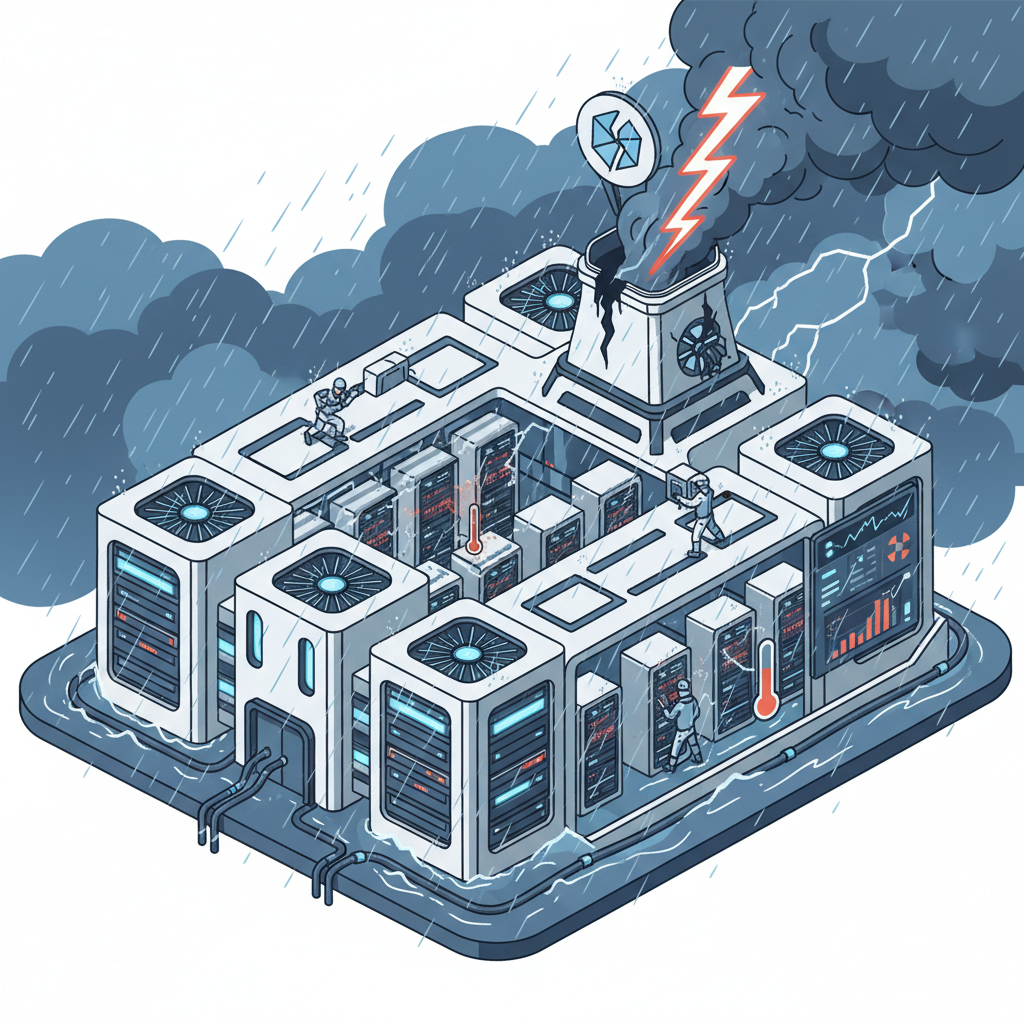
A storm-triggered cooling failure caused the Namecheap outage of August 14, 2026. Here’s what the incident actually shows about vendor concentration risk.
Table of Contents
Namecheap Outage: Executive Summary & Key Incident Details
- Incident Date: Thursday, August 14, 2026
- Provider & Facility: Namecheap, RadiusDC data center (Phoenix)
- Facility Classification: Tier 3 data center with high built-in redundancy
- Historical Context: First outage of its kind in the company’s 25-year operating history
- Root Cause: A storm caused a physical cooling system failure
- Impacted Services: Hosting services, the EasyWP platform, and email services
- Unaffected Services: DNS resolution and URL forwarding remained operational throughout the incident
A storm, a cooling system, and a 25-year clean record that ended on August 14
On Thursday, August 14, 2026, a storm caused a cooling system failure at Namecheap’s RadiusDC data center in Phoenix, and the resulting outage took down hosting services, the EasyWP platform, and email services for affected customers. DNS resolution and URL forwarding, core network routing functions, kept working throughout, but for customers whose hosting or email lived in the affected facility, the practical experience was straightforward downtime. Namecheap has since confirmed services are back online and said it would assess its systems and evaluate additional redundancy measures, a reasonable response for an incident with a physical, weather-driven root cause rather than a software or process failure.
What makes this incident worth more than a single day’s headline is a detail Namecheap itself included in its response: the RadiusDC facility is described as a Tier 3 data center with a high level of built-in redundancy, and this was still the first outage of its kind in the company’s 25-year operating history. That’s not a company with a track record of instability. It’s a well-regarded provider with real redundancy infrastructure that still went down, because a specific, physical failure (a cooling system knocked out by a storm) sits outside what most redundancy planning accounts for.
Impact Analysis of Single-Provider Consolidation
Outage postmortems are common enough that it’s easy to read past one more of them. This one is worth pausing on for a specific reason: a lot of small businesses deliberately consolidate their domain registration, hosting, and email with a single provider because it’s simpler to manage, one login, one bill, one support relationship. That consolidation is a completely reasonable trade-off for most small businesses; managing multiple vendors adds real operational complexity that usually isn’t worth it just to hedge against a low-probability event.
But it does mean that when the single provider a business consolidated around has a bad day, everything tied to that provider has a bad day at the same time. A business with domain registration, website hosting, and email all under one vendor doesn’t have three independent points of failure. It effectively has one.
That’s the actual lesson from a well-run, Tier 3, 25-year-clean-record provider still going down: redundancy inside a single facility, generators, backup cooling, failover systems, protects against a lot of failure modes, but it doesn’t eliminate the risk entirely, and a business relying on a single provider for everything is exposed to whatever that provider’s remaining risk is, however small.
Risk Mitigation Strategies Without Added Complexity
The practical answer isn’t “use multiple hosting providers,” advice that genuinely does add more operational overhead than it’s worth for most small businesses managing their own site. A more useful distinction is between consolidating vendors, which is fine, and consolidating single points of failure without realizing it, which is the actual problem. A few specific habits address that gap directly.
Email is the highest-value thing to decouple from a single outage, since a business that can’t receive email during an outage can’t hear from customers, can’t process support requests, and in some cases can’t even complete password resets to fix other affected systems. Using a dedicated email service, even from the same overall provider but running on genuinely separate infrastructure, or a distinct email provider entirely, means an infrastructure-level outage doesn’t also take out the channel a business needs to communicate about the outage itself.
Domain registration and hosting are more reasonable to keep together for most small businesses, since the operational simplicity is real and the specific risk (a registrar-level outage, as opposed to a hosting outage) is a narrower category. What matters more here is confirming your registrar has domain locking enabled and multi-factor authentication turned on for the account, since an outage is a temporary inconvenience but an account compromise during or after one is a much worse problem, and the two risks compound if a provider’s incident response is stretched thin handling the outage itself.
It’s also worth checking what your own host’s service level guarantees actually promise before you need them, not after, since the fine print on uptime commitments and credits is a lot easier to read on a calm afternoon than in the middle of an outage.
Backups are the last piece, and the one most often assumed rather than verified. A backup stored on the same infrastructure as the live site doesn’t protect against the exact scenario Namecheap just experienced, a facility-level failure that takes out everything hosted there simultaneously, backup included. Confirming backups are stored somewhere genuinely separate, and that a restore has actually been tested rather than just configured, is worth doing on a calm day rather than finding out the gap exists during the next facility-level incident, wherever it happens.
The pattern shows up beyond hosting and email too
The same consolidation risk applies to DNS and CDN, not just hosting and email, and it’s easy to overlook because those pieces often live with the same provider by default rather than by a deliberate decision. If your DNS resolution, your CDN, and your hosting all sit with one company, a single infrastructure failure at that provider can take your site fully offline even if your actual server or files are untouched, because visitors can’t resolve your domain to any address at all.
Namecheap’s own incident is a useful example of the opposite: DNS resolution and URL forwarding kept working throughout the outage specifically because those functions ran on infrastructure separate from the affected data center, which is exactly the kind of internal separation that limited the blast radius of this particular failure.
A quick self-audit worth doing on a calm afternoon
Three questions cover most of what matters here, and none of them require a technical audit, just checking your own account dashboards. Does your business have one login that, if temporarily unavailable, would take out your website, your email, and your ability to register or renew domains simultaneously? Is at least one channel, ideally email, running on infrastructure genuinely separate from your main hosting, so you can still hear from customers and coordinate a response during an outage of the other?
And has anyone on your team actually tested restoring a backup from storage that isn’t sitting on the same server as the live site, rather than just confirming a backup file exists? A “no” to the first and a “yes” to the other two is a reasonable target for a small business, not because outages are common, but because a 25-year clean record ending on one ordinary Thursday is a reminder that “rare” isn’t the same as “won’t happen to you.”
None of this is a case against consolidating with a single, reliable provider, and it’s not really a criticism of Namecheap specifically, whose response, transparency about the cause, and stated redundancy track record are what a well-run provider’s response to a genuine failure should look like. It’s a reminder that “redundant” and “immune to outages” aren’t the same claim, and a 25-year clean record ending on one specific day is a useful, low-cost prompt to check whether your own setup has any single point where a bad day for one provider becomes a bad day for your entire business at once, particularly around email and backups, the two places that consolidation risk shows up hardest and gets noticed last.
Storms, hardware failures, and cooling systems are not predictable events a business can plan around individually, and no provider, however well-run, can promise otherwise. What a business can plan around is how much of its own operation goes dark at once when one of them happens, and that number is worth knowing before the next unpredictable event picks the facility your business happens to depend on.
Related reading: Namecheap was back in the news in late September, when a federal judge ordered it to explain why it shouldn’t be sanctioned in a domain dispute; see Namecheap’s $50K ACPA Order and What It Means for Your Domain.